
The crocodile verdict – Let the Animals Live vs. Hamat Gader holiday resort. The unprecedented verdict and the central claim interpreting the Animal Protection law. The verdict pertains to a show described as “man-crocodile fight” which in fact was a series of manipulations, causing distress to the crocodile and sending a message to the viewers about man’s control over wildlife. At the request of Let the Animals Live, the court issued a warrant to ban the show. The verdict was overrun by a higher court and after an appeal the case was discussed at the Supreme Court. The verdict issued by judge Heshin, is an unprecedented interpretation of the 1994 Animal Protection law and the prohibition of abuse. The court states that abuse happens whenever man causes unjustified suffering to animals – even if the suffering isn’t severe. Justification is determined based on measure. If the act has redeeming value, excluding it from abuse, than there must be adequate cause and purpose. It also must be proven that there are no other less harmful means to gain the same purpose. In order to convict a person of criminal abuse one must show that the person was aware of the suffering they caused to the animal – no need for special intent, sadistic motive and so forth. The court determined that the show constitutes abuse and is against the law: the entertainment of viewers does not justify causing suffering to animals.
Rabies Quarantine Petitions
HCJ 4210/00 Nagar v. Tel Aviv District Health Office; HCJ 5654/00 Kaushansky v. Dr. Nadel; HCJ 6207/01 Avnit v. Dr. Nadel
As early as 2000, Let the Animals Live filed a series of petitions against the automatic quarantine of dogs that had bitten. The petitions were dismissed after becoming moot, as the quarantine periods ended and the dogs were released. The organization continued to oppose the automatic quarantine policy and promoted legislative initiatives on the issue. In 2016, after Kaya, the adopted dog of the Netanyahu family, bit Knesset Member Sharren Haskel, the government began advancing legislation allowing home observation instead of quarantine.
The Cats Petition
HCJ 4884/00 Let the Animals Live v. Director of Veterinary Services
This ruling put an end to the mass killing of community cats. The Court invalidated a Veterinary Services procedure for handling stray cats, holding that a mere nuisance that does not amount to severe and serious harm to public welfare cannot justify killing cats or causing them significant suffering. Less harmful alternatives must be preferred, and discretion must remain with public veterinarians even when private contractors are used.
The Tschingel Petition
HCJ 1096/01 Let the Animals Live v. The Attorney General
The background to the petition concerned an individual named Tschingel who was documented holding a pigeon over the navel of a person presented as suffering from jaundice and strangling it. He claimed that he believed this act to be a folk remedy with curative properties. He was prosecuted; however, the Attorney General ordered a stay of proceedings against him (the practical effect of a stay of proceedings is the withdrawal of the indictment).
Let the Animals Live petitioned against the stay of proceedings, but the Supreme Court, which is generally disinclined to intervene in decisions of this nature made by the Attorney General, dismissed the petition.
The Malish Case
HCJ 5711/02 The Association for Ethical Science v. The Council for Animal Experimentation
(Let the Animals Live was the third petitioner)
The petition was directed against a cruel and unnecessary experiment conducted on four monkeys at the Hebrew University. Shocking images from the experiment were exposed by a student who worked in the laboratory and may be viewed online.
In light of a factual dispute between the parties, which the Supreme Court was unable to resolve, the matter was referred for handling within the framework of the statutory mechanism established under the Animal Experimentation Law. Although the legal proceedings themselves ultimately dissipated, the experiment was halted following the exposure. Three of the four monkeys survived, were removed from the laboratory, and transferred to rehabilitation.
The ATLS Petition
HCJ 9374/02 Let the Animals Live v. Chief Medical Officer
The petition was directed against the use of live dogs in a trauma treatment training course (ATLS). The course was conducted within a military framework, but was also intended for civilian surgeons. The use of dogs in such courses is problematic, inter alia, because canine anatomy differs fundamentally from human anatomy.
For example, a letter by Dr. Yosef Behagon was attached to the petition, in which he stated:
“Approximately one week after the laboratory exercise, during the routine treatment of a terror-attack casualty, I inserted a chest drain due to pneumothorax from which the injured person was suffering. My unequivocal conclusion following the insertion of the drain is that it was successfully inserted not because of the prior training, but despite it. Due to the anatomical differences between dogs and humans, there is no connection whatsoever between the prior training and the technical skill it allegedly imparts, and the skill actually required in practice.”
Moreover, in the United States a mannequin simulating the human body was introduced for use in these courses, and training with this simulator was proven to be more effective than training on live dogs. The mannequin was officially recognized as an alternative to the use of live dogs and was used to train hundreds of surgical physicians each month.
In response to the petition, however, Prof. Ribakind, who was responsible for the course, argued that work on (anesthetized) dogs provided several advantages that could not, at that stage, be replicated by a mannequin, including the flow of warm blood, the sensation of pulse and breathing, the feel of living skin, and the emotional experience of treating a living body with a beating heart and respiration.
The Court declined to intervene in the professional dispute regarding the effectiveness of the simulator and dismissed the petition. Following the dismissal, and as a result of pressure from physicians, the simulator was introduced into use and training on dogs was discontinued. According to information available to us, as of 2017 the Medical Corps conducts its training using advanced simulators, although animals are still used in some contexts. Advanced simulator-based trauma courses are also conducted outside the Medical Corps.
The Animal Transport Regulations Petition
HCJ 1662/03 Let the Animals Live v. Minister of Agriculture
This petition had two aspects. First, the organization demanded that the Minister of Agriculture enact regulations under the Animal Protection Law concerning the transport of animals. Second, the organization sought to halt the live shipments of lambs and calves from Australia that were destined for slaughter in Israel (sometimes after a period of fattening).
Following the filing of the petition, the Ministry of Agriculture renewed its work on drafting the regulations, and in 2006 regulations were enacted concerning the transport of cattle, sheep, and pigs. In addition, a substantial change was made to the manner in which animals were brought from Australia to Israel.
The petition placed particular emphasis on the severe abuse suffered by animals that were unloaded at the port of Aqaba, left waiting for long hours in the scorching sun at the border crossing near Eilat, and violently transferred at the border from Jordanian trucks to Israeli trucks. As a result of the petition, the shipment route was changed, and the unloading of animals was moved to the port of Eilat.
In light of these achievements, the Court struck the petition while imposing significant costs on the State, which had taken action as a result of the filing of the petition. Ten years later, the organization once again petitioned against live shipments.
Petition Concerning “Magen LaChatul”
HCJ 5990/03 Let the Animals Live v. State Attorney’s Office
The background to the petition involved a business known as “Magen LaChatul” that collected and killed community cats. The State Attorney’s Office prosecuted the operator of the business. However, after the criminal case had progressed and was close to judgment, the State Attorney’s Office withdrew the indictment.
The indictment was withdrawn on the grounds that, in another case pending before the Supreme Court, the State Attorney’s Office had defended the use made by municipal veterinarians of the very same business’s “services.” Let the Animals Live petitioned against the withdrawal of the indictment, but the Court dismissed the petition, holding that it intervenes only in rare cases in prosecutorial decisions and does not compel the prosecution to conduct a criminal case it does not wish to pursue.
In a second petition filed by Let the Animals Live, it was subsequently determined that cats may not be killed solely on the grounds that they constitute a nuisance, and that the use made by municipal veterinary services of the “services” of “Magen LaChatul” was unlawful.
The First Mazor Petition
HCJ 9637/03 Let the Animals Live v. Minister of Environmental Protection
The petition challenged the importation of monkeys from Mauritius to the Mazor farm, a facility engaged in breeding monkeys for sale for laboratory experimentation in Israel and abroad. The petition demonstrated that the importation of the monkeys contradicted the policy that Israel had previously declared to the parties to the Convention on International Trade in Endangered Species of Wild Fauna and Flora (CITES).
Following the filing of the petition, instead of halting the importation, the State notified the parties to the CITES Convention that it was relaxing the previously stringent conditions governing the trade in monkeys with Israel. The Supreme Court dismissed the petition, holding that the importation of the monkeys complied with the terms of the new, relaxed policy.
The Animal Holding Regulations Petition
HCJ 9926/03 Let the Animals Live v. Minister of Agriculture
In this petition, Let the Animals Live demanded that the Minister of Agriculture enact regulations under the Animal Protection Law concerning the conditions under which animals are kept in pet shops, municipal pounds, petting zoos, shelters, private homes, and similar settings.
The petition set in motion the regulatory process. The legal advisor to the Knesset Education Committee convened a working group tasked with drafting the regulations, with the participation of government representatives, veterinarians, and representatives of civil society organizations. Approximately six years after the petition was filed, the process concluded successfully with the enactment of the Animal Protection (Protection of Animals) (Non-Agricultural Holding) Regulations, 2009.
These regulations remain, to this day, a central enforcement tool for the implementation of the Animal Protection Law.
The Dangerous Dogs Petition
HCJ 6976/04 Let the Animals Live v. Minister of Agriculture
In this petition, Let the Animals Live sought the Court’s intervention to invalidate a series of restrictive arrangements imposed on dogs belonging to breeds that had been defined as “dangerous.” The organization argued that there is no such thing as a dangerous dog breed, but rather dangerous humans. In other words, it maintained that not artificial breed classifications, but rather a dog’s history of treatment and training, determine its temperament and behavior and may render it dangerous.
The Court held that the arrangement allowing a dog to be defined as dangerous on the basis of its breed is anchored in the statute itself, and that the Supreme Court rarely intervenes in legislation enacted by the Knesset. Although expert opinions and evidence were presented to demonstrate that defining a dog’s dangerousness based on its breed is arbitrary, the Court noted that there is also contrary evidence, as well as legislative arrangements in other countries that similarly rely on breed-based classifications.
This was characterized as a scientific dispute in which the administrative authority is entitled to adopt one position. In light of this, the petition was dismissed.
The Disengagement Petition
HCJ 7707/05 Let the Animals Live v. Administration for Assistance to the Residents of the Gaza Strip and Northern Samaria
The petition concerned assistance to animals that had been abandoned following the evacuation of settlements במסגרת the “Disengagement Plan.” As a result of the petition, practical arrangements were established that enabled animal welfare organizations to access the area, evacuate abandoned animals, and find appropriate solutions for their care.
Petition for Enforcement of the Ban on Force-Feeding of Waterfowl
HCJ 7713/05 Noah – The Israeli Federation of Animal Protection Organizations v. The Attorney General
(Let the Animals Live was the third petitioner)
This petition sought to compel the authorities to enforce the ban on the force-feeding of waterfowl, in accordance with a prior ruling of the Supreme Court. After the Ministry of Agriculture failed to advance legislation intended to circumvent the Court’s earlier decision, the State notified the Court of an enforcement framework for the force-feeding ban—albeit belatedly.
The Court reproached the State for its disregard of the initial judgment, and in light of the proposed enforcement framework (even though implemented with delay), dismissed the petition while ordering the State and the force-feeders to pay costs.
The “Parade of Beasts” Petition
HCJ 9178/06 Let the Animals Live v. Israel Police
The petition challenged the police permit granted for the “Parade of Beasts,” which was planned as a protest against the Pride Parade in Jerusalem. The Supreme Court dismissed the petition in light of the importance of freedom of assembly and based on an assessment that the animals intended to be used in the “Parade of Beasts” would not be caused suffering.
The Court emphasized that it was to be expected that the demonstrators would strictly comply with the Animal Protection Law. It should be noted that, in a separate case, the veterinary services of the Jerusalem Municipality seized animals that were exploited for the purpose of a “Parade of Beasts,” on grounds of animal welfare concerns.
The Second Mazor Petition
HCJ 2351/12 Let the Animals Live v. Israel Nature and Parks Authority
The petition sought to prevent the Mazor farm from exporting to research laboratories female monkeys that had been captured in the wild in Mauritius and imported into Israel for use as a “breeding nucleus.” The Mazor farm presented itself as a monkey-breeding facility that used wild-born monkeys only as an initial breeding nucleus. According to this presentation, only second-generation monkeys—born at the farm—were to be sent to laboratories for experimentation, after being separated from their families.
It later emerged, however, that the farm intended to export the wild-born mother monkeys themselves for experimentation as well. As a result of the petition, the planned shipment was halted, and it was determined that the farm was not permitted to export wild-born monkeys for use in experiments.
Further information regarding the petition is available on the organization’s website.
The Pig Holding Regulations Petition
HCJ 3393/12 Let the Animals Live v. Minister of Agriculture
This petition sought the enactment of regulations governing the manner in which pigs are kept in Israel’s pork industry. In Israel, approximately two hundred thousand pigs are killed each year for meat production. Pigs—animals of high intelligence, great curiosity, and rich social lives—are kept in crowded, filthy enclosures devoid of stimulation.
As part of the industrial rearing method, sows are confined for prolonged periods in crates that do not allow any movement; male piglets are castrated; and the tails and teeth of all piglets are docked. Mortality rates among piglets in the industry are extremely high, and those that survive are separated from their mothers at a very young age.
As a result of the petition, the Ministry of Agriculture enacted the requested regulations. Although these regulations are among the most advanced in the world, the extensive suffering within the industry continues.
Further information on the struggle to enact the pig holding regulations is available on the organization’s website.
HCJ 4238/12 Let the Animals Live v. Minister of Agriculture
This petition concerned the annual budget of NIS 4.5 million that was allocated, pursuant to an amendment to the Animal Protection Law, for the purpose of reducing the reproduction of stray animals. במסגרת a petition filed by the organization under the Freedom of Information Law several years after the amendment entered into force, it was revealed that the funds had not been fully allocated, that the procedures required for their allocation had not been properly carried out, and that part of the funds had been allocated to purposes unrelated to the reduction of stray animal populations.
In light of these findings, the petition was filed with the Supreme Court. As a result of the petition, the State regularized the procedures for allocating the funds, and they were designated exclusively for the spaying and neutering of street cats. Nevertheless, the organization was required to petition the Supreme Court twice more in order to ensure the regular allocation of the budget.
Further information regarding the petition is available on the organization’s website.
The Colored Fish Petition
HCJ 6932/12 Let the Animals Live v. Chief Fisheries Officer
This petition challenged the importation of fish that had undergone tattooing or artificial coloring. This horrific practice is one aspect of the cruel yet often overlooked industry of trading fish intended for decorative purposes (“ornamental fish”).
As a result of the petition, the relevant regulations were amended to prohibit the sale in Israel of fish that had undergone artificial coloring or tattooing. In addition, a condition was added to ornamental fish import licenses, prohibiting the importation of fish that had been subjected to these procedures.
Further information on the issue and the petition is available on the organization’s website.
The “Rabbit Logo” Petition
HCJ 8826/12 Let the Animals Live v. Ministry of Health
This petition challenged a directive issued by the Ministry of Health instructing cosmetics companies not to use the rabbit logo, which indicates that a company does not conduct animal experiments itself or through others, and does not use raw materials that were tested on animals after a specified date.
Following the filing of the petition, the Ministry of Health announced that there was no impediment to companies using the rabbit logo, and that responsibility for determining the criteria governing use of the logo rests with animal protection organizations.
Further information regarding the petition is available on the organization’s website.
The Adom–Adom Petition
HCJ 8976/12 Anonymous – Association for Animal Rights v. Director of Veterinary Services
(Let the Animals Live was the second petitioner)
This petition was filed after the organization Anonymous exposed severe abuse at the Adom–Adom slaughterhouse operated by Tnuva. Slaughterhouse workers were documented systematically electrocuting calves; beating calves and lambs; dragging calves unable to walk along the ground; suspending animals in the air while still conscious after their throats had been cut; and abusing animals in numerous other ways—all as part of routine working methods.
Although the petition did not result in the closure of the slaughterhouse, it led the Veterinary Services to issue a binding procedure for slaughterhouses that adopts internationally accepted standards, and to order the installation of surveillance cameras in slaughterhouses.
Criminal Leave to Appeal 2675/13 State of Israel v. Vachnun
A request to join the proceedings as amicus curiae in a criminal appeal concerning an acquittal on grounds of reasonable doubt of an individual charged with force-feeding waterfowl after the ban on such practices had entered into force.
The Nordia Chicks Petition
HCJ 7408/14 Let the Animals Live v. Ministry of Agriculture
This petition challenged a lenient plea bargain reached with the “Nordia” hatchery after it was revealed that the hatchery had disposed of live chicks by throwing them into a garbage container, where they died slowly and painfully. Each year in Israel, hatcheries kill millions of chicks that hatch with disabilities or defects, as well as male chicks of egg-laying breeds. The law requires that such chicks be ground or crushed in machines designed to cause a quick death. In Nordia, however, the chicks were discarded in a trash container and left to die slowly.
Despite the severe abuse of these fragile and defenseless animals, Attorney Jiris Jantos, the prosecutor on behalf of the Ministry of Agriculture, settled for a plea bargain imposing only a symbolic fine of NIS 15,000 on the hatchery. Let the Animals Live petitioned against the plea bargain, which was described even by the Attorney General as excessively lenient. Nevertheless, the Attorney General requested that the Supreme Court not intervene in the agreement, and the Court indeed left the decision as to whether to accept the plea bargain to the court hearing the criminal case.
The court handling the case approved the plea bargain, and the hatchery was fined only NIS 15,000 for its actions. However, in light of the affair, it was determined that plea bargains that do not include a custodial sentence must be brought to the attention of the State Attorney’s Office in advance, in order to enable the Attorney General to intervene. It was further determined that animal protection organizations must be heard with respect to such plea bargains.
The Hunting with Dogs Petition
HCJ 2971/15 Let the Animals Live v. Israel Nature and Parks Authority
This petition challenges permits issued by the Israel Nature and Parks Authority allowing hunting with the use of dogs. Hunting with dogs involves setting dogs upon wild boars and leads to severe and cruel injuries to the dogs, the boars, and other wildlife present at the hunting site.
At the time of writing, the petition is still pending.
The Proneuron Case
CA 4051/15 Teva v. Proneuron
Let the Animals Live sought to join the proceedings as amicus curiae in a civil case between two biotechnology companies, which revolved around a clinical trial intended to examine whether the drug Copaxone could benefit patients suffering from ALS. The trial did not demonstrate any benefit from the use of the drug among ALS patients, and the dispute between the biotechnology companies centered on the question of whether the trial had been properly designed, as required under the contract between them.
Among other issues, the question arose as to whether additional animal experiments were required prior to conducting the clinical trial, and what significance should be attributed to the animal experiments that had in fact been conducted. In its request to join the proceedings, Let the Animals Live pointed out that there is no valid animal model for ALS—that is, no animal species naturally develops ALS, and all attempts to induce diseases with similar symptoms in animals have failed to produce a model from which reliable inferences can be drawn from animals to humans.
Let the Animals Live asked that the Court’s judgment not be one that would lead to the conduct of animal experiments merely for the sake of legal cover, where such experiments have no value in advancing scientific research. The request to join the proceedings was denied; however, the Court stated that it would remain mindful of the issues raised therein.
The First Dabah Petition
HCJ 4196/15 Let the Animals Live v. Director of Veterinary Services
This petition was filed following the exposure of severe and systematic abuse of animals at the Dabah slaughterhouse in Deir al-Asad, which at the time was the largest slaughterhouse in Israel. The abuse was uncovered by the organization Animals Australia using hidden cameras.
The footage revealed, inter alia, extreme violence against animals, the dragging of sheep by their legs, intensive use of electric prods, the throwing of sheep from trucks, and abuse of dying calves after their throats had been cut. Calves whose throats had already been slit were filmed getting up on their feet and attempting to flee. Workers were seen breaking the tails of dying calves and swinging them by their legs into the air onto a conveyor belt leading to carcass processing.
Following the investigation, the slaughterhouse was closed for several days and changes were introduced. As a result of the petition, the Veterinary Services’ slaughterhouse procedure was amended, and instructions were established requiring an immediate response by the supervising veterinarian in cases of deviation from the procedure—including halting the slaughter until deficiencies were remedied. In addition, the Ministry of Agriculture issued a tender to equip all slaughterhouses and abattoirs in Israel with cameras installed at all sensitive points, transmitting footage to a central monitoring center.
The Second Spay/Neuter Petition
HCJ 7445/15 Let the Animals Live v. Minister of Agriculture
The Animal Protection Law provides that each year the State shall allocate NIS 4.5 million for the prevention of the reproduction of stray animals. Following an earlier petition filed by Let the Animals Live, the budget was allocated on a regular basis for the spaying and neutering of street cats.
In 2015, the Ministry of Agriculture delayed the allocation of the budget, apparently due to halakhic objections by the Minister and the Director General to spaying and neutering. Proposals were raised, such as using the funds to transfer cats and dogs to foreign countries willing to receive them. Ultimately, the Minister of Agriculture decided that the budget would be transferred to the Chief Scientist of the Ministry of Agriculture, who would issue a call for research proposals concerning methods for preventing the reproduction of stray animals that would comply with halakhic requirements.
As a result of the petition, and following the intervention of the Attorney General, the funds were allocated for the spaying and neutering of street cats.
The Live Shipments Petition
HCJ 7622/15 Let the Animals Live v. Director of Veterinary Services
This petition challenged the cruel live shipments of calves and lambs from Europe and Australia to Israel—prolonged journeys of suffering undertaken solely for the purpose of slaughtering the animals in Israel. As if the sentence of slaughter were not enough, industry actors, with the approval of the Ministry of Agriculture, subject these animals—lambs and calves—to journeys of torment, sometimes from one end of the world to the other.
For many days and even weeks, the animals are transported by land and sea, in trucks and on ships. Repeated loading and unloading are invariably frightening and often violent. On board the ships, the animals are confined in crowded pens, standing in their own excrement and that of others. An animal that does not adapt to the feed provided on the ship may die of starvation; others suffer from disease, and some die. The bodies are thrown into the sea and not infrequently wash up on Israel’s shores.
The petition emphasized that all professional authorities agree that if animals are to be slaughtered, this should be done as close as possible to the place where they were born and raised, and that live shipments should be replaced with trade in meat. Israel can import fresh meat from animals slaughtered near their place of origin, and such meat would even be cheaper for consumers. Under these circumstances, permits for the importation of live animals are disproportionate and unlawful.
The Zoglovek Petition
HCJ 7199/16 Let the Animals Live v. Haifa District Attorney’s Office
This petition challenged the refusal of the Haifa District Attorney’s Office to allow animal protection organizations to file a private criminal complaint (a procedure parallel to an indictment) against Zoglovek and its employees, following the exposure of animal abuse in a slaughterhouse through an undercover investigation conducted by the organization Anonymous.
The abuses documented included, inter alia: the violent collection of turkeys that had been thrown from cages which fell from a truck following a traffic accident; abandoning poultry in cages without food or water for many long hours—several times longer than permitted under the regulations—causing unimaginable suffering; keeping birds in non-standard and defective cages that trapped their limbs between the bars, resulting in severe injuries and suffering; shaking and tilting cages so that birds repeatedly fell from great heights, or were violently tossed while suspended between the bars by their heads, wings, or other body parts; forcibly tearing birds from cages when their legs were caught between the bars; cruelly grabbing birds and throwing them through the air over long distances; and throwing live, injured, and bleeding birds (after their throats had been cut) into metal containers, where they were left to die slowly.
The District Attorney’s Office delayed handling the case for more than two years and, only in early 2017—following the filing of the petition—made the highly troubling decision to close the case. In the course of the proceedings, it was determined that the prosecution would transfer the investigation materials to the organization and allow it to file an appeal against the closure of the case, which it subsequently did.
The Slaughterhouse Subsidies Petition
HCJ 7516/16 Let the Animals Live v. Minister of Economy
This petition challenged the granting of subsidies, from public funds, to slaughterhouses. Beyond the inherent harm caused to animals, the subsidies were argued to be detrimental, as they support an industry that is destructive to the environment and promotes the production of food whose consumption the Ministry of Health itself recommends reducing.
Moreover, the expansion of slaughterhouses in Israel would also encourage the cruel live shipments of animals from Australia and Europe to Israel, instead of slaughtering animals close to the place where they were born and raised and replacing journeys of death with trade in meat.
The petition was struck after the Court clarified that it would not intervene in the broad discretion vested in the government with respect to the granting of subsidies.
The Third Spay/Neuter Petition
HCJ 7761/16 Let the Animals Live v. Minister of Agriculture
After the annual budget for preventing the reproduction of stray animals was allocated in 2015 only as a result of a petition filed by Let the Animals Live, in 2016 the publication of the call for proposals for allocating the funds was delayed. In October, when the year was already nearing its end without a call for proposals having been issued, Let the Animals Live petitioned the Supreme Court. As a result of the petition, the call for proposals for the years 2016 and 2017 was published.
The “Hanging While Conscious” Petition
HCJ 8488/16 Let the Animals Live v. Director of Veterinary Services
This petition was filed following an undercover investigation conducted by People for the Ethical Treatment of Animals (PETA) and the organization Anonymous at five slaughterhouses in three Latin American countries. The investigation revealed cruel working methods that contravened accepted international standards and the binding procedures applicable in Israel.
Workers were filmed knocking calves to the ground or slamming them onto the floor and restraining their heads using a hook inserted into their noses and a pitchfork-like device. Immediately after cutting the calves’ throats, they were hoisted onto an overhead conveyor, from which they were suspended by a single leg. The calves remained conscious for an extended period while hanging in this manner, during which time workers cut into them and severed the spinal cord using a spike—an act that does not cause loss of consciousness. Processing of the carcasses began without verifying that the calves had lost consciousness or died.
As a result of the petition, the Ministry of Agriculture announced that it would prohibit the importation of meat from slaughterhouses operating using these prohibited methods and would permit meat imports only from slaughterhouses equipped with approved restraining devices.
The First “Failure to Respond” Petition
HCJ 8858/16 Let the Animals Live v. Ministry of Agriculture
This petition was filed against the systematic failure of officials at the Ministry of Agriculture to respond to communications from Let the Animals Live concerning the enforcement of the Animal Protection Law across a wide range of areas. The petition detailed 13 serious and representative examples of complaints that received no response.
The Ministry of Agriculture was accused of failing to exercise its enforcement powers in a reasoned and comprehensive manner. The organization complained that it repeatedly reported severe violations of the Animal Protection Law to the Ministry of Agriculture, yet “the inquiries seem to be swallowed into a black hole,” as stated in the petition. “Not only does the respondent (the Ministry of Agriculture) fail to provide the petitioner (the ‘Let the Animals Live’ organization) with a substantive response,” the petition noted, “but to the best of the petitioner’s knowledge, it does not provide the inquiries with the required handling at all—neither by taking steps to prevent the continuation of the abuse, nor by conducting criminal investigations, filing indictments, or imposing administrative fines.”
The petition was struck after the Ministry of Agriculture responded to all of the inquiries and issued a new procedure for handling animal welfare complaints. Following the responses to the individual complaints, the organization continued to pursue some of the matters through appeal proceedings against the closure of investigation files.
HCJ 880/17 Tzedek LaKol v. Ministry of Environmental Protection
(Let the Animals Live joined as a co-petitioner)
Let the Animals Live joined as one of the petitioners in an animal-protection organizations’ petition demanding that the State assume responsibility for the fate of the monkeys that remained at the Mazor farm after its closure. As a result of the petition, the State allocated a budget to maintain the monkeys for a period of two years.
The Second Dabah Petition
HCJ 3152/17 Let the Animals Live v. Prosecution Unit of the Ministry of Agriculture
This petition challenged the refusal of the Ministry of Agriculture to allow animal-protection organizations to review the materials accumulated in the investigation file concerning the systematic abuse of animals at the Dabah slaughterhouse. The Ministry of Agriculture closed the case without indicting anyone, in a decision that was, on its face, deeply troubling. The decision suggested that no genuine investigation had been conducted in the affair.
Initially, the Ministry of Agriculture approved access to the file. However, once it realized that the organizations might also make media use of the materials—potentially embarrassing the Ministry and the industry—it withdrew its consent. The petition is currently pending.
The Beit Shemesh Dogs Petition
HCJ 5880/17 Tzedek LaKol v. Minister of Agriculture
(Let the Animals Live sought to join as amicus curiae)
Let the Animals Live applied to join the proceedings as amicus curiae in a petition challenging the shooting of free-roaming dogs in Beit Shemesh. In its application, the organization emphasized alternative measures to killing the dogs, foremost among them the option of capturing the dogs, sterilizing them, vaccinating them, and returning them to their environment.
The organization argued that reasonable measures had not been exhausted before the authorities resorted to killing, and that the justification for shooting the dogs was not a threat to public health but rather citizen complaints regarding nuisance and fear—concerns that can be addressed through other means and, in any event, do not justify killing. The shooting permit was not implemented, and the petition was struck.
The Quail Hunting Petition
HCJ 7624/17 Society for the Protection of Nature in Israel v. Director of the Israel Nature and Parks Authority
(Let the Animals Live joined as co-petitioner)
Let the Animals Live joined the Society for the Protection of Nature in Israel in a petition against the hunting of quail, and in particular against the use of “sound traps”—devices that lure quail to congregate around a speaker playing recorded quail calls. Once the quail gather around the speaker, the hunter shoots them to death.
Following the petition, the Israel Nature and Parks Authority announced that it would not allow the use of sound traps until June 2019, and that during this period it would consider removing quail altogether from the list of species permitted for hunting. In light of this announcement, the petition was struck.
The Haifa Slaughterhouse Petition
HCJ 8020/17 Let the Animals Live v. Director of Veterinary Services
In 2017, severe abuse of animals was exposed at the Haifa slaughterhouse. Video footage from the facility showed workers systematically and violently beating animals with long wooden rods (in one instance until the rod broke on the animal’s back). Workers were also seen pushing sheep from a truck without a proper ramp, dragging sheep by their legs, and lifting them by gripping their wool, tails, or horns.
After slaughter, workers suspended the animals in the air while they were still conscious and began cutting into the bodies and skinning them while the animals continued to show signs of consciousness—and much more. It emerged that similar violations documented in the undercover footage had previously been recorded by the Veterinary Services, yet were not halted.
The petition seeks the closure of the slaughterhouse and the completion of the project to equip slaughterhouses in Israel with a comprehensive camera system transmitting footage to a central monitoring center. The petition is currently pending.
The Spaying and Neutering Budget for Dogs Petition
HCJ 8022/17 Let the Animals Live v. Minister of Agriculture
By the end of 2017, the annual call for proposals for the spaying and neutering of community (street) cats for the year 2018 had still not been published. That same year, a new provision was added to the Law for the Regulation of Supervision of Dogs, establishing an additional annual budget of NIS 4.5 million (starting in 2017) for reducing the reproduction of stray dogs. This budget, too, was not used.
The petition was filed demanding that the Ministry of Agriculture publish the procedure for the spaying and neutering of street cats and allocate the funds—pursuant to the Law for the Regulation of Supervision of Dogs—for spaying and neutering activities.
Following the petition, the procedure for the spaying and neutering of street cats for 2018 was published. However, with respect to the budget intended to reduce the reproduction of stray dogs, the Ministry of Agriculture announced proposed courses of action whose connection to reducing reproduction was, at best, tenuous.
The petition remains pending, with its focus now on the purposes for which the budget for reducing the reproduction of stray dogs will be used.
Petition to Enforce the Regulations for the Protection of Pigs
HCJ 927/18 Let the Animals Live v. Ministry of Agriculture
In 2015, following an earlier petition, the Ministry of Agriculture enacted regulations establishing minimum standards for the keeping of pigs in Israel’s pork industry. Each year, this industry sends approximately 200,000 pigs to slaughter, and it is characterized by some of the most cruel practices found in animal agriculture—at least with respect to mammals. The regulations were intended to mitigate some of these practices. For example, they set maximum stocking densities for pigs; restrict the confinement of sows in restraint systems that prevent all movement; require the use of pain relief during the routine castration of piglets and during the cutting of their teeth and tails; and mandate minimal environmental enrichment for these intelligent, curious animals, among other measures.
However, even after the regulations entered into force, the Ministry of Agriculture failed to act effectively to enforce them. In the initial period, inspections of pig farms were conducted by a ministry-appointed swine veterinarian, but despite finding systematic violations of the regulations, the Ministry did not employ effective enforcement tools against the offenders. After the swine veterinarian left his position in March 2017, supervision of pig farms ceased entirely.
The petition demands effective enforcement of the regulations. The petition is currently pending.
Petition for the Publication of Investigation Materials in the 2013 Zoglovek Case
HCJ 2210/18 Let the Animals Live v. Haifa District Prosecutor’s Office
Following an earlier petition filed by Let the Animals Live, the organization received the investigation materials relating to the 2013 animal abuse case at the Zoglovek slaughterhouse and filed an appeal against the decision to close the case.
The present petition seeks to allow the organization to make public and media use of these materials, in order to expose the regulatory and supervisory failures at the slaughterhouse and to demonstrate the unreasonableness of the decision to close the criminal file.
Enforcement of Regulations on the Transport of Animals
HCJ 2211/18 Let the Animals Live v. Director of the Veterinary Services
In 2006, following an earlier petition by Let the Animals Live, the Ministry of Agriculture enacted regulations governing the transport of cattle, sheep, goats, and pigs. To enable oversight and enforcement, the regulations require that every transport be accompanied by a written document detailing, inter alia, the place and time of loading and unloading, the vehicle’s area, and the number of animals transported.
It has since emerged that the Ministry of Agriculture does not enforce this documentation requirement, thereby depriving itself of the central tool needed to monitor compliance with the regulations. The petition demands that the Ministry enforce the documentation obligation. The petition is pending.
Appointment of a Head of the Animal Welfare Division
HCJ 3286/18 Let the Animals Live v. Minister of Agriculture
This petition seeks the appointment of a head of the Animal Welfare Division within the Veterinary Services. In December 2015, the government adopted a decision to advance the protection and welfare of animals. A central component of this decision was the establishment of an Animal Welfare Division within the Veterinary Services and the appointment of a senior-level director responsible for the field.
The decision followed deliberations of an interministerial committee that examined transferring animal welfare authorities from the Ministry of Agriculture to the Ministry of Environmental Protection. One of the key problems identified was the insufficient allocation of personnel within the Ministry of Agriculture, leaving responsible officials overburdened and without adequate institutional backing. Appointing a division head was intended to significantly increase staffing and the division’s standing within the ministry and the civil service.
Despite the decision in late 2015—explicitly stating that the position would be added immediately—the tender to fill the post was published only at the end of 2017. Even after publication, delays continued and no division head was appointed. The petition is pending.
Budget for the Spaying and Neutering of Dogs
HCJ 8022/17 Let the Animals Live v. Minister of Agriculture
By the end of 2017, the annual call for proposals for the spaying and neutering of street cats for 2018 had not yet been published. That same year, a new provision was added to the Law for the Regulation of Supervision of Dogs, establishing an additional annual budget of NIS 4.5 million (from 2017 onward) to reduce the reproduction of stray dogs. This budget, too, was not used.
The petition demanded that the Ministry of Agriculture publish the procedure for spaying and neutering street cats and allocate the funds designated under the Law for the Regulation of Supervision of Dogs to spaying and neutering activities. Following the petition, the procedure for spaying and neutering street cats for 2018 was published. However, regarding the budget intended to reduce the reproduction of stray dogs, the Ministry of Agriculture announced intended courses of action whose connection to reducing reproduction was, at best, tenuous.
The petition was ultimately struck out after the budget under the Law for the Regulation of Supervision of Dogs was also allocated, with the Court emphasizing that, in the future, the Ministry of Agriculture must use this budget for the specific purpose for which it was intended—reducing the reproduction of stray dogs.
The Kafr Qassem Market
HCJ 8752/17 Let the Animals Live v. Ministry of Agriculture
Every Saturday, a weekly market operates in the town of Kafr Qassem. Among other activities, animal traders from across the country come to the market and offer animals for sale. The conditions in which the animals are kept at the market are extremely harsh and constitute a blatant and ongoing violation of the law and the relevant regulations. Among other things, animals are kept amid constant and severe noise, in unbearable overcrowding, fully exposed to the movement of people and to harassment, with no place to hide. They are often held without food or water, in extreme heat. Animals are handed over without any care instructions—sometimes even to people who have no idea how to care for them. Despite the fact that these violations occur in broad daylight, week after week and for years, the Ministry of Agriculture failed to carry out effective enforcement measures at the site that would put an end to the abuse. The petition demanded that the Ministry conduct effective enforcement at the market. Following the petition, enforcement actions were taken and continue to be taken at the site, and the petition was struck out.
The State’s Appeal Regarding the Construction Plan at Apollonia
Administrative Appeal 9403/17 The Committee for the Planning of Preferred Housing Complexes v. Carmeli
Let the Animals Live was a respondent in the State’s appeal against a decision of the District Court that had annulled a plan to build a luxury residential neighborhood north of Herzliya. The plan would have led to the destruction of an open area that is home to many animals—one of the few such areas remaining along the central Israeli coastline. Among other things, the area is vital to a herd of gazelles that lives there. The groves within the area, near the seashore, also serve as an essential resting site for migratory birds arriving from over the sea. The Supreme Court, by majority, decided to accept the appeal and approve the construction plan. However, in the subsequent further hearing, the position advanced by us and by the other petitioners in that proceeding was accepted, and it was decided to annul the plan due to defects in the environmental survey that had been conducted prior to the plan’s approval.
Enforcement of the Regulations for the Protection of Pigs
HCJ 927/18 Let the Animals Live v. Ministry of Agriculture
In 2015, following an earlier petition, the Ministry of Agriculture enacted regulations establishing minimum conditions for the keeping of pigs in the meat industry. Each year, this industry sends approximately 200,000 pigs to slaughter, and it employs some of the most cruel practices found in livestock farming—at least with respect to mammals. The regulations were intended to mitigate some of these practices. For example, they set a maximum stocking density for pigs; restrict the prolonged confinement of sows in restraining stalls that prevent any movement; require the use of pain relief during the routine castration of piglets and the cutting of their teeth and tails; and mandate minimal environmental enrichment for these intelligent and inquisitive animals, among other measures.
However, even after the regulations entered into force, the Ministry of Agriculture did not act effectively to enforce them. During the initial period, inspections were still carried out by a pig veterinarian on behalf of the Ministry at pig farms. Yet despite the veterinarian’s findings of systematic violations of the regulations, the Ministry failed to employ effective enforcement measures against the offenders. After the pig veterinarian left his position in March 2017, supervision of the farms ceased entirely.
The petition demands effective enforcement of the regulations designed to protect pigs. In response to the petition, the Ministry of Agriculture reported on various training and enforcement plans, the full implementation of which has been delayed. The petition remains pending.
Enforcement of the Regulations on the Transport of Animals
HCJ 2211/18 Let the Animals Live v. Director of Veterinary Services
In 2006, following an earlier petition by Let the Animals Live, the Ministry of Agriculture enacted regulations governing the transport of cattle, sheep, goats, and pigs. In order to enable oversight of compliance with these regulations, they require that every transport be accompanied by a written document detailing, inter alia, the place and time at which the animals were loaded onto the truck, the place and time at which they were unloaded, the surface area of the truck, the number of animals transported, and similar particulars.
It has become apparent, however, that the Ministry of Agriculture does not enforce this requirement, thereby depriving itself of the central tool for supervising compliance with the transport regulations. The petition demands that the Ministry of Agriculture enforce this obligation. In the course of the proceedings, the Ministry of Agriculture informed the Court that it intends to implement a digital system for reporting animal transports in the near future. The petition remains pending.
Appointment of the Head of the Animal Welfare Division
HCJ 3286/18 Let the Animals Live v. Minister of Agriculture
This petition concerns the appointment of a Head of the Animal Welfare Division within the Veterinary Services. In December 2015, the government adopted a decision aimed at advancing the protection and welfare of animals. One of the central pillars of that decision was the establishment of an Animal Welfare Division within the Veterinary Services and the appointment of a senior-level director to be responsible for the field.
The decision followed deliberations by an interministerial committee that examined the possibility of transferring the authorities relating to the prevention of cruelty to animals from the Ministry of Agriculture to the Ministry of Environmental Protection. One of the key problems presented to the committee was that the Ministry of Agriculture had not allocated sufficient manpower to the field, and that the officials responsible for animal welfare within the Ministry were overburdened and did not receive adequate institutional backing. Appointing a division head was intended to significantly increase both manpower and the standing of the division within the Ministry and the civil service.
Despite the fact that the decision was adopted at the end of 2015 and provided that the position would be added immediately, a tender for staffing the position was published only at the end of 2017. Even after the tender was published, delays continued and no division head was appointed. After the Ministry of Agriculture acted to cancel the results of the first tender, a candidate lacking expertise in animal welfare—who had been involved in cruel animal experiments—was appointed in the second tender. As part of the petition, we sought the annulment of her appointment.
Following a hearing, it was decided to transfer the discussion of the matter to the Labor Court, where the proceedings are still ongoing as of December 2025.
Fifth Petition Concerning the Budget for the Spaying and Neutering of Cats
HCJ 321/19 Let the Animals Live v. Minister of Agriculture
In 2019 as well, the budget designated for reducing the reproduction of cats was delayed. Following the petition, and after numerous delays—stemming in part from the fact that no new government was formed in Israel during 2019—the call for proposals for the allocation of the budget was published toward the end of the year. In light of this development, the petition was withdrawn.
Zoglovek – Criminal Prosecution
HCJ 5437/19 Let the Animals Live v. Deputy State Attorney for Criminal Affairs
The complaint we filed following an investigation that exposed severe abuse at the Zoglovek slaughterhouse in 2013 led to a criminal investigation, at the end of which it was decided to close the case without indicting anyone. Only as a result of a separate petition to the High Court of Justice did we receive the decision to close the case and the investigative materials, after which we filed an appeal against the closure. The appeal was rejected by the State Attorney’s Office without addressing the substantive arguments raised regarding the decision to close the case. An alternative request we submitted to the Haifa District Attorney’s Office, seeking permission to file a private criminal complaint, was also denied.
In this petition, we asked the Court to order the prosecution to accept our appeal and to prosecute the Zoglovek company and its senior executives for the serious offenses revealed in the investigation and the inquiry. Alternatively, we asked the Court to order the prosecution to allow us to file a private criminal complaint against them. Following a hearing, the Court struck out the petition with our consent, due to the passage of time since the exposure of the incidents.
In its judgment, the Court emphasized the importance of protecting animals, including in cases of abuse that do not stem from sadism, but rather from indifference to the fate of animals.
Private Kennels
HCJ 6449/19 Let the Animals Live v. Director of Veterinary Services
Many local authorities in Israel transfer dogs that are captured within their jurisdictions to private kennels, which operate as municipal quarantine facilities. As early as 2016, a representative of the Ministry of Agriculture announced the Ministry’s intention to act toward terminating the operation of private kennels as municipal quarantine facilities—and not without reason. The data indicate that these kennels are often run in a problematic manner, with a tendency to euthanize dogs as quickly as possible once the minimal statutory holding periods have elapsed, and without the municipal veterinarian fulfilling the duty to weigh the required considerations prior to euthanasia.
In a decision issued in November at the first hearing on the petition, the Court clarified that municipal veterinarians must make any decision to euthanize an animal personally and in writing. Freedom of Information requests that we submitted to all local authorities across the country reveal a troubling picture regarding the euthanasia of dogs in quarantine facilities, particularly in private ones. In June 2020, the Court issued an order nisi directing the Ministry of Agriculture to explain why it should not order the cessation of the operation of private kennels as municipal quarantine facilities. A hearing on the petition is expected to take place soon.
Second Petition Concerning the Budget for the Spaying and Neutering of Dogs
HCJ 7763/20 Let the Animals Live v. Minister of Agriculture
Despite the Court’s comments and the State’s undertaking in HCJ 8022/17 Let the Animals Live v. Minister of Agriculture, in 2020 the Minister of Agriculture again decided to allocate the NIS 4.5 million designated for reducing the reproduction of stray dogs to purposes wholly unrelated to that objective.
In the petition filed in November 2020, we demanded the annulment of allocations to projects that are unrelated to the spaying and neutering of dogs—the very purpose for which the statutory provision allocating the annual NIS 4.5 million budget was enacted. In parallel with the petition, we filed a motion for an interim order prohibiting the allocation of the budget to purposes other than spaying and neutering pending a decision on the petition, and prohibiting the return of the funds to the State treasury.
In the petition, we argued that allocating the budget to purposes unrelated to reducing the reproduction of dogs—such as digital adoption days or research on owned dogs—was done ultra vires and is therefore unlawful. We also maintained that no meaningful consultation had been conducted with the Minister of Environmental Protection, whose position, as well as that of the professional bodies in her Ministry, was that the budget should be used for spaying and neutering.
The petition was struck out by consent after the Court declined to intervene in the Ministry of Agriculture’s discretion, without addressing the question of authority.
Freedom of Information Appeal – Animal Experiments at Academic Institutions
Administrative Appeal 840/21 Let the Animals Live v. Bar-Ilan University et al.
This appeal was filed against the judgment of the Tel Aviv District Court, which accepted the arguments of Bar-Ilan University, Tel Aviv University, and the Hebrew University of Jerusalem that disclosure of information concerning animal experiments conducted at academic institutions would disproportionately harm the universities’ commercial interests. The District Court further held that the confidentiality provision in the Animal Experimentation Law—applicable to those who receive information by virtue of their role under the Law—dictates a cautious approach to the disclosure of information relating to animal experiments.
In the appeal, we emphasized the lack of any substantive or research-based foundation for the claim of commercial secrecy, particularly in light of the academic nature of these institutions. We also highlighted the problematic interpretation of the confidentiality provision in the Animal Experimentation Law as affording protection against disclosure to institutions that themselves conduct the experiments.
The Supreme Court proposed a framework whereby an application would be submitted to the Chair of the Council for Animal Experimentation, requesting that the confidentiality over the information be lifted, while preserving the parties’ respective arguments. The appeal concluded by agreement on this basis. Subsequently, an application was submitted to the Chair of the Council, which was denied, and a new petition was filed against that decision. That petition is currently pending before the Jerusalem District Court.
Second “Failure to Respond” Petition
HCJ 1844/21 Let the Animals Live v. Ministry of Agriculture
In this petition, we asked the Supreme Court to issue orders directing the Ministry of Agriculture—specifically, the Animal Welfare Division within the Veterinary Services and the PIFZUAH (Enforcement and Inspection Unit)—to comply with the provisions of the Criminal Procedure Law and with the procedures for handling offenses involving cruelty to animals that the Ministry itself had formulated following our first “failure to respond” petition in 2016.
In the petition, we detailed a series of cases in which Ministry officials acted contrary to the established procedures, including failures to open investigations, failures to notify complainants of the closure of cases, and failures to provide updates to complainants, among other deficiencies.
The petition was struck out on the ground that it was overly “broad,” with the Court clarifying that we remain free to petition in specific, individual cases.
Appeals Against Decisions Not to Prosecute – Dabbah Slaughterhouse and Zoglovek Slaughterhouse
HCJ 3051/21 Let the Animals Live v. Ministry of Agriculture and Rural Development
This petition was filed against the Ministry of Agriculture for its failure to forward to the Appeals Department of the State Attorney’s Office the appeals we submitted against decisions not to prosecute the Dabbah slaughterhouse and its employees in connection with offenses involving cruelty to animals that were exposed in an investigation conducted there in 2015, as well as against the decision not to prosecute the Zoglovek company and its officeholders in connection with offenses exposed in the investigation at its poultry slaughterhouse in 2015.
Following the petition, the appeal concerning Dabbah was transferred to the Appeals Department of the State Attorney’s Office, where it was rejected. With respect to Zoglovek, since junior employees at the slaughterhouse were prosecuted following the investigation, and based on case law in another proceeding holding that there is no right of appeal in cases where only some of the suspects in an “incident” are prosecuted, the Court ruled that no right of appeal exists in the circumstances of this case as well, and dismissed the petition in early 2023.
Motion to Join as Amicus Curiae in an Appeal Concerning the Import Ban on Stingray Fish
Administrative Appeal 7203/21 Trigalo v. Israel Nature and Parks Authority
Through the Clinic for Environmental Justice and the Protection of Animal Rights at Tel Aviv University, we sought to join as amicus curiae in an appeal filed by a private individual against a judgment that had accepted the position of the Israel Nature and Parks Authority (INPA), according to which it was not required to allow him to import a “genetically engineered” stingray fish into Israel.
In addition to the INPA’s arguments concerning biodiversity and the classification of the fish as a protected natural asset, we sought to raise arguments relating to considerations of the protection and welfare of the animals themselves. Ultimately, our motion to join was not adjudicated, as the Court recommended that the appellant not persist in his appeal, and the appeal was dismissed while adopting the INPA’s position regarding the fish’s legal status as a protected natural asset.
Third “Failure to Respond” Petition – The Pet Shop in Tayibe
HCJ 8616/21 Let the Animals Live v. Ministry of Agriculture
Following the Court’s comments in the previous “failure to respond” petition, we filed the present petition concerning a specific complaint that had not been handled or responded to in accordance with the procedure for handling offenses involving cruelty to animals and the Criminal Procedure Law.
After the Court ordered an expedited response, the State informed the Court that the complaint had been “handled,” and that it had not seen fit to update us accordingly. Since the relief sought—opening an investigation—had been granted, we requested that the petition be struck out, and it was so ordered.
From the Ministry of Agriculture’s response it emerged that the authorities are aware of shortcomings in notifying complainants of the opening of an investigation or of decisions not to open an investigation, and the PIFZUAH officials undertook before the High Court of Justice that such notifications would be provided in the future. As of today, such updates are provided only partially, at best.
Appeal Against the Euthanasia of Birds Smuggled into Israel
Administrative Appeal 1019/22 Let the Animals Live v. Director of Veterinary Services, Ministry of Agriculture
This appeal was filed against the judgment of the Lod District Court, which dismissed our petition challenging the euthanasia of birds that had been smuggled into Israel from Jordan. The position of the Director of Veterinary Services was that it was impossible to determine whether the birds were diseased because they lacked health certificates, and that it was not feasible to keep them in quarantine; therefore, euthanasia was unavoidable.
This position was maintained despite the fact that no concrete suspicion of any dangerous disease arose (and tests ruled out those diseases that were raised by the Director before the Court), and despite the Director’s own admission that the birds were not being held in quarantine, contrary to the Court’s instructions. Our request for interim relief prohibiting the euthanasia of the two birds that had survived until the conclusion of the appeal proceedings was denied, and the birds were euthanized.
Because the appeal became theoretical following the euthanasia of the birds, it was agreed that the appeal would be dismissed, with the clarification that this did not constitute a principled ruling on the Ministry’s general policy, and that we would be able to raise our arguments on the issue again in the future.
Freedom of Information Appeal – Haifa Slaughterhouse
Administrative Appeal 1699/22 Let the Animals Live v. Ministry of Agriculture and the Haifa Slaughterhouse
This appeal was filed against the judgment of the Lod District Court, which dismissed our petition seeking disclosure of “non-compliance” reports documenting deficiencies at the Haifa slaughterhouse in the period preceding the publication, in 2017, of footage exposing severe cruelty to animals at the facility. The District Court accepted the Ministry of Agriculture’s argument that the supervising veterinarians’ fear of the conduct of the supervised entities (the slaughterhouses), should the reports be disclosed, constituted a valid reason for withholding the information.
In the appeal, we argued that the District Court’s decision contradicted established case law governing freedom of information and claims that disclosure would impair the functioning of a supervisory authority. During the hearing before the Supreme Court, the justices on the panel criticized the Ministry of Agriculture’s rationale that violence or threats by regulated entities could justify concealing information from the public.
At the Court’s suggestion, a compromise was reached regarding the disclosure of the information, and the judgment of the District Court was set aside.
Exemption from Customs Duties on Red Meat and Processed Meat
HCJ 5656/22 The Forum for Sustainable Nutrition, Let the Animals Live et al. v. Minister of Finance, Minister of Agriculture et al.
This was a joint petition filed together with the organization Animals, environmental organizations, and public health organizations and experts, and in cooperation with the Clinic for Environmental Justice and the Protection of Animal Rights at Tel Aviv University. The petition sought to annul the decision of the Minister of Finance to grant a customs duty exemption on red meat and to establish a temporary customs duty exemption on processed meat.
In the petition, we argued that this decision violates the right to health—particularly of vulnerable populations—by encouraging the consumption of harmful food contrary to the recommendations of the Ministry of Health; that it causes severe environmental harm, contrary to the position of the Ministry and Minister of Environmental Protection; and that it further encourages harm to animals in the industry. The Supreme Court dismissed the petition with our consent, while clarifying in its judgment that it recognizes the importance of the discussion regarding the health, social, and environmental issues raised by the petition.
Installation of Animal Welfare Regulations for Slaughterhouses
HCJ 2918/23 Let the Animals Live v. Minister of Agriculture
This petition seeks an order directing the Minister of Agriculture to enact regulations establishing minimum welfare standards in slaughterhouses (excluding poultry slaughterhouses), in accordance with the Minister’s duty under Amendment No. 10 to the Prevention of Cruelty to Animals Law of 2015. That amendment provided that the Minister of Agriculture must submit draft regulations for approval by the Knesset’s Education Committee within nine months—a requirement that had not been fulfilled by the time the petition was filed.
In the petition, we emphasized the Minister’s obligation to act in accordance with this explicit statutory instruction, despite a delay of approximately seven years. In its response, the State did not deny the existence of this obligation; however, as of May 2025 it had still not completed the formulation of a draft. In May 2025, the State argued for the first time that, prior to submitting the regulations, it was necessary to prepare a regulatory impact report, which it claimed “may take a long time.”
The petition has been scheduled for a hearing in May 2026. In the meantime, the Ministry published a call for public comments on the matter, without attaching a draft of the proposed regulations for comment, but rather referring only to an outdated and inadequate procedure of the Veterinary Services.
Amendment of the Animal Welfare Regulations Concerning the Transport of Livestock
HCJ 3689/23 Let the Animals Live v. Minister of Agriculture and Director of Veterinary Services, Ministry of Agriculture
This petition sought an order directing the Ministry of Agriculture to act in accordance with its undertaking in HCJ 2211/18 and to submit to the Knesset’s Education Committee an amendment to the Animal Welfare Regulations concerning the transport of livestock. Among other reasons, the Ministry itself had claimed that the current wording of the regulations does not allow for effective tracking of the written documentation accompanying animal transports.
At the Ministry’s request, the hearing on this petition was consolidated with the hearing on the petition concerning animal welfare regulations for slaughterhouses. Here too, the State did not deny the Minister of Agriculture’s duty to amend the regulations in accordance with the Ministry’s prior undertaking. In the status update notices it filed, the State repeatedly sought to postpone the date for implementing its commitment.
Ultimately, in the second half of 2024, a draft amendment was placed on the table of the Knesset’s Education Committee, and the petition was struck out by agreement. As of December 2025, the proposed regulations are still under discussion in the Education Committee.
Appeal Concerning the Conditions of Pig Husbandry at the Research Institute in Kibbutz Lahav
Civil Leave to Appeal 4620/23 Let the Animals Live v. The Institution and Institute for Animal Science and Research, Kibbutz Lahav
In an application for leave to appeal in a “third instance,” we sought permission to appeal the decisions of the Magistrates’ Court and the Be’er Sheva District Court regarding the applicability of the Prevention of Cruelty to Animals Regulations at the site. Our argument was that, in light of the Institute’s claim that the exploitation of the pigs for the marketing of their meat is merely a “byproduct” of their being kept for research purposes—a claim that enables the Institute to raise pigs notwithstanding the provisions of the Pig Raising Prohibition Law—the standards applicable to non-agricultural keeping should apply.
The Magistrates’ Court and the District Court held that the nature of the pigs’ husbandry at the Institute conforms to the standards set out in the Prevention of Cruelty to Animals Regulations governing agricultural keeping. The Supreme Court decided that this was not a case warranting the grant of leave to appeal in a “third instance,” as the determination was rooted in the concrete, fact-specific circumstances of the husbandry practices at the research institute.
Third Petition Concerning the Budget for Reducing the Reproduction of Stray Dogs
HCJ 8212/23 Let the Animals Live v. Minister of Agriculture
This additional petition was filed toward the end of 2023, seeking an order directing the Minister of Agriculture to allocate the budget mandated by law for reducing the reproduction of stray dogs. The petition was submitted after repeated approaches to the Ministry, and with due consideration given to the outbreak of the war on October 7, 2023, and its impact on the Ministry’s operations.
In its response, the Ministry informed the Court that it had decided to allocate the budget to local authorities located along the “front line,” by way of an exemption from a tender process. After several status updates, culminating in notice that the exemption had been approved, the petition was struck out at our request in early January 2024, and the costs of the petition were imposed on the Ministry.
Failure to Respond to a Request for Approval of a “Protected Facility”
HCJ 2278/24 Let the Animals Live v. The Authority Appointed under the Prevention of Cruelty to Animals Law, Ministry of Agriculture
This petition sought an order directing the Animal Welfare Division of the Ministry of Agriculture to make a decision regarding our applications to have our shelter and clinics recognized as “protected facilities,” to which animals seized under the Prevention of Cruelty to Animals Law may be transferred, after our requests had gone unanswered for many months.
Following the filing of the petition, the Division took steps to examine our applications and recognized the shelter as a protected facility. As a result, the petition was struck out at our request, and the costs of the proceedings were imposed on the Division.
“Hot Slaughter” Petition
HCJ 3655/24 Let the Animals Live v. Director of the Veterinary Services, Ministry of Agriculture
This petition sought an order directing the Director of the Veterinary Services to take the necessary steps to halt the operation of an unlicensed shop and slaughter facility that was operating on a main street in Nazareth and offering on-site “hot slaughter” of roosters, in violation of the law. The petition was filed after our repeated approaches to the Ministry of Agriculture failed to result in sufficient enforcement action.
In its response, the Ministry claimed that enforcement measures had already been taken. However, our own inspection showed that the operation was still active. After we updated the Court accordingly, and shortly before the scheduled hearing, inspectors from the Ministry of Agriculture confiscated the birds and the slaughter equipment at the site, and the operation was shut down.
As a result, the petition was withdrawn at our request, and the Ministry of Agriculture was ordered to pay the costs of the proceedings.
Petition on the Prohibition of Sow Confinement and Mutilation of Pigs in the Meat Industry
HCJ 62172-11-24 Let the Animals Live v. Minister of Agriculture
In the Animal Welfare (Protection of Animals) Regulations concerning the keeping of pigs in the meat industry—enacted following a petition we filed to the High Court of Justice in 2012—it was permitted to confine nursing sows in crates that prevent all movement for up to two weeks, and to allow routine tail docking, teeth clipping, and castration of piglets without anesthesia or analgesia. At the same time, the Ministry of Agriculture was required to examine the necessity of continuing these practices and to present its conclusions to the Knesset’s Education Committee.
The conclusions of the researcher appointed by the Ministry were unequivocal: these practices cause severe suffering to sows and piglets, and there are less cruel alternatives available that do not entail economic harm to farmers. Despite the Ministry’s commitment to amend the regulations accordingly—a commitment that led to the suspension of primary legislation that had been advanced on the issue—no such regulations were formulated to date.
In November 2024, we filed a petition to the High Court of Justice seeking an order directing the Minister of Agriculture to enact regulations in line with the scientific findings, the prohibition on cruelty under the Animal Welfare Law, and the Ministry’s explicit commitment to the Knesset. In its response, the Ministry of Agriculture argued that alongside the filing of the petition it had resumed work on preparing a regulatory impact assessment for the regulations. This work, however, had been halted for nearly two years following the dissolution of the 24th Knesset, despite the Ministry’s earlier statements that as early as 2022 the work was close to completion. The Ministry requested that the petition be dismissed.
The Knesset submitted its own response, emphasizing that the Ministry of Agriculture had indeed committed before the Education Committee to advance the regulations, and that doing so was consistent with the professional findings presented to the Committee. The Court ordered the Ministry of Agriculture to submit an update on its progress by mid-June 2025.
Petition to Prohibit the Use of Horses for Crowd Control
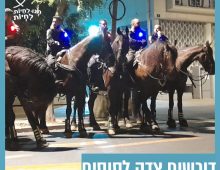
HCJ 52836-11-24 Let the Animals Live v. Israel Police
Following an increased police reliance on mounted units at demonstrations, amid the intensification and proliferation of protests, we filed a petition to the High Court of Justice in November 2024 demanding the immediate cessation of the use of horses for dispersing demonstrations. The petition was filed on behalf of Let the Animals Live by Attorney Amnon Keren of the Environmental Justice and Animal Rights Clinic at Tel Aviv University.
Horses are highly sensitive animals. Their use in crowd control exposes them to significant suffering. The training (“conditioning”) process they undergo within the police force is designed to break their spirit and suppress their natural instinct to flee from danger and distressing situations—but it does not eliminate the distress itself. In routine operations, mounted officers use painful and outdated equipment and apply substantial force to the horses.
In the petition, we argued that the use of horses for dispersing demonstrations constitutes a violation of the Animal Welfare (Protection of Animals) Law, and that the police have numerous alternative means at their disposal for crowd control that do not involve causing such harm to animals.
After repeated delays, in early June the police submitted their response to the petition, asserting that the use of horses at demonstrations is necessary. One limited achievement was recorded: the police amended their internal procedures to reduce the maximum continuous deployment time of horses from six hours to three hours. However, the response did not include additional safeguards, such as limits on cumulative daily working hours (which may still reach up to ten hours per day), restrictions related to extreme weather conditions, or substantive engagement with the other arguments raised in the petition.
The petition has been scheduled for a hearing in March 2026.
HCJ – Prohibition of Confinement of Sows and Mutilation of Pigs in the Meat Industry
HCJ 62172-11-24 Let the Animals Live v. Minister of Agriculture
In the Animal Welfare (Protection of Animals) Regulations concerning the keeping of pigs in the meat industry, enacted following a petition we filed with the High Court of Justice in 2012, it was determined that certain practices would be permitted: the confinement of nursing sows in crates that do not allow movement for a period of two weeks; the cutting of piglets’ tails and teeth; and the castration of piglets without anesthesia or analgesia. At the same time, the Ministry of Agriculture was required to examine the necessity of continuing these practices and to present its conclusions to the Knesset’s Education Committee.
The conclusions of the review conducted by a researcher on behalf of the Ministry were that these practices cause severe suffering to piglets and sows, and that there are less cruel alternatives that do not entail economic harm to farmers. Despite the Ministry’s commitment to amend the regulations accordingly (a commitment that led to the suspension of primary legislation that had been advanced on the issue), no such regulations were formulated to date.
In November 2024, we petitioned the High Court of Justice seeking an order directing the Minister of Agriculture to enact such regulations in accordance with the scientific findings, the prohibition on cruelty set out in the Animal Welfare Law, and the Ministry’s commitment to the Knesset. In its response, the Ministry of Agriculture stated that, concurrently with the filing of the petition, it resumed work on preparing a regulatory impact assessment regarding the regulations—a process that had been halted for nearly two years following the dissolution of the 24th Knesset, despite the Ministry’s prior representations that as early as 2022 the work on the report was nearly complete—and requested that the petition be dismissed.
The Knesset submitted its response, emphasizing that the Ministry of Agriculture had indeed committed before the Education Committee to act toward enacting the regulations, and that this commitment was consistent with the professional findings presented to it. In June 2025, the Ministry of Agriculture updated that the regulatory impact assessment had been completed and submitted to the Education Committee, and that its conclusion was that there was no justification for amending the regulations at all. Following this development, the parties requested that the petition be dismissed while preserving their arguments. The petition was dismissed, with costs awarded in our favor, and in light of the highly problematic content of the regulatory impact assessment, we again approached the Minister of Agriculture in August 2025.
HCJ – Budget for Reducing the Reproduction of Cats and Fourth Petition Regarding the Budget for Reducing the Reproduction of Dogs
HCJ 21427-02-25 Let the Animals Live v. Minister of Agriculture
An additional petition filed at the beginning of 2025, seeking an order directing the Minister of Agriculture to publish calls for proposals for the allocation of the budgets prescribed by law for reducing the reproduction of stray cats and dogs. The petition was filed following requests to the Minister to act to publish the calls for proposals for the allocation of these budgets.
In April, a call for proposals was published for local authorities regarding the allocation of the budget for reducing the reproduction of cats, and in September a call for proposals was published regarding the budget for reducing the reproduction of dogs. As a result, the petition was dismissed, and the Ministry was ordered to pay costs in an unprecedented amount for petitions of this kind—NIS 25,000.
In addition, the Court stated that “the respondents would do well to ensure that from now on they act, on their own initiative, in accordance with the provisions of these laws, and thereby spare the petitioner the need to resort, in these matters, to the services of this Court—something that has become, against its will, an (almost) annual tradition for it.”
HCJ – Use of PAPP Poison Baits
HCJ 62586-06-25 Let the Animals Live v. Director of the Veterinary Services, Ministry of Agriculture
In May 2025, the Director of the Veterinary Services published a procedure permitting local authorities to use PAPP poison baits for the purpose of poisoning dogs. This poison is used primarily for poisoning dogs and cats in Australia and New Zealand. The procedure was formulated without consultation with professional bodies at the Ministry of Environmental Protection or the Israel Nature and Parks Authority, while disregarding extensive scientific evidence regarding the suffering caused by the poisoning and the risk of poisoning other animals, and without establishing even minimal safety measures to prevent and address unintended poisonings.
As we did not receive a substantive response from the Director, we filed a petition with the High Court of Justice in June, together with a request for an interim order to prevent poisonings in the meantime. The request for an interim order was denied, and a hearing on the petition was scheduled for June 2026.
HCJ – Extension of the Transitional Period Allowing the Confinement of Laying Hens in Conditions of Extreme Density
HCJ 62143-07-25 Let the Animals Live (R.A.) et al. v. Minister of Agriculture
On July 6, 2025, a second amendment to the Animal Welfare (Protection of Animals) Regulations concerning laying hens in the egg industry entered into force. This followed a previous amendment from 2024, which extended the period during which hens may be kept in conditions of extreme crowding—350 square centimeters per hen (instead of 750 square centimeters)—on the grounds that the war, and in particular the fighting in northern Israel, prevented implementation of the regulations.
The second extension, granting an additional three years, was enacted on the basis of the same justification, despite having been adopted after the ceasefire along the northern border, which was the main front relevant to egg producers. In practice, statements by the Minister of Agriculture and by poultry growers’ organizations made clear that these measures were intended to erode the standards set out in the regulations, which already included an exceptionally generous transitional period for cage-free facilities, extending until 2037.
Given that it was evident that the extension of the regulations—adopted without consultation with professional authorities in the fields of poultry welfare or public health—was driven by irrelevant considerations and relied on the war as a pretext, we filed a petition with the High Court of Justice in July 2025 together with the organization Animals. The petition seeks a declaration that the amended regulations are void. The deadline for filing responses to the petition was set for the end of October 2025. In its most recent decision, the Court ruled that the petition will be scheduled for a hearing.
HCJ – Glue Traps
HCJ 54645-11-25 Let the Animals Live v. Minister of Environmental Protection
Glue traps are among the most cruel methods used in pest control. Animals caught in them injure themselves in attempts to escape, and if the traps are not monitored, they are left to suffer and slowly die. Moreover, glue traps are non-selective: lizards, birds, and even kittens may become trapped in them and die after prolonged agony.
The Regulation of the Occupation of Sanitary Pest Control Law, 2016, authorizes, inter alia, the Minister of Environmental Protection to designate certain tools as “treatment measures,” the use of which is restricted to licensed pest controllers only. The law further required that, by 2019, regulations be enacted addressing, among other things, “instructions concerning the selection of means whose harm to the environment, animals, or public health is lesser.”
In the petition we filed in November 2025, we asked the Court to order the Minister of Environmental Protection to classify glue traps as “treatment measures,” and to enact regulations governing their use by licensed pest controllers, with the aim of reducing animal suffering to the greatest extent possible.